Custom ERP vs SAP, Tally and Zoho: An Honest Comparison for Indian Businesses
Custom ERP vs SAP Business One, Tally and Zoho: fit, flexibility, ownership, integration, training and cost drivers — and when each is the right choice.
If you are choosing an ERP for small business in India, the shortlist usually looks the same: TallyPrime because the accountant already uses it, Zoho because it is cloud and cheap to start, SAP Business One because it sounds serious, and a custom ERP because a developer said he can build exactly what you want. This article compares custom ERP vs SAP, Tally and Zoho honestly — including the cases where you should not build anything custom at all.
What each option actually is
TallyPrime
Tally is accounting-first software used by a very large share of Indian businesses. TallyPrime covers accounting, inventory, GST invoicing, e-invoice and e-way bill generation, bills of materials and job work. It is sold as a one-time lifetime licence — Silver for a single user, Gold for multiple users on a local network — or as a rental plan. Upgrades, statutory updates and connected services such as online e-way bill and e-invoice generation depend on an active Tally Software Services (TSS) subscription. Custom screens and reports are built by Tally partners using TDL.
Zoho (Books, Inventory, One, Creator)
Zoho is a family of cloud apps. Zoho Books handles accounting and GST, Zoho Inventory handles stock, orders and warehouses, and Zoho One bundles dozens of apps including CRM, HR and analytics. Zoho Creator is a low-code platform for building your own apps on top. Zoho's own Inventory help pages describe composite items for simple assemblies, but have stated that dedicated manufacturing modules are not yet supported, so check the current feature list if you run a factory. Pricing is subscription-based.
SAP Business One
SAP Business One is SAP's ERP for small and mid-sized companies — not the same product as SAP S/4HANA used by large enterprises. It covers finance, sales, purchasing, inventory, production with multi-level BOMs and MRP, CRM and service. It is sold and implemented through SAP partners, on-premise or cloud-hosted, with named-user licensing. Implementation by a partner is part of the project, not an optional extra.
Custom ERP
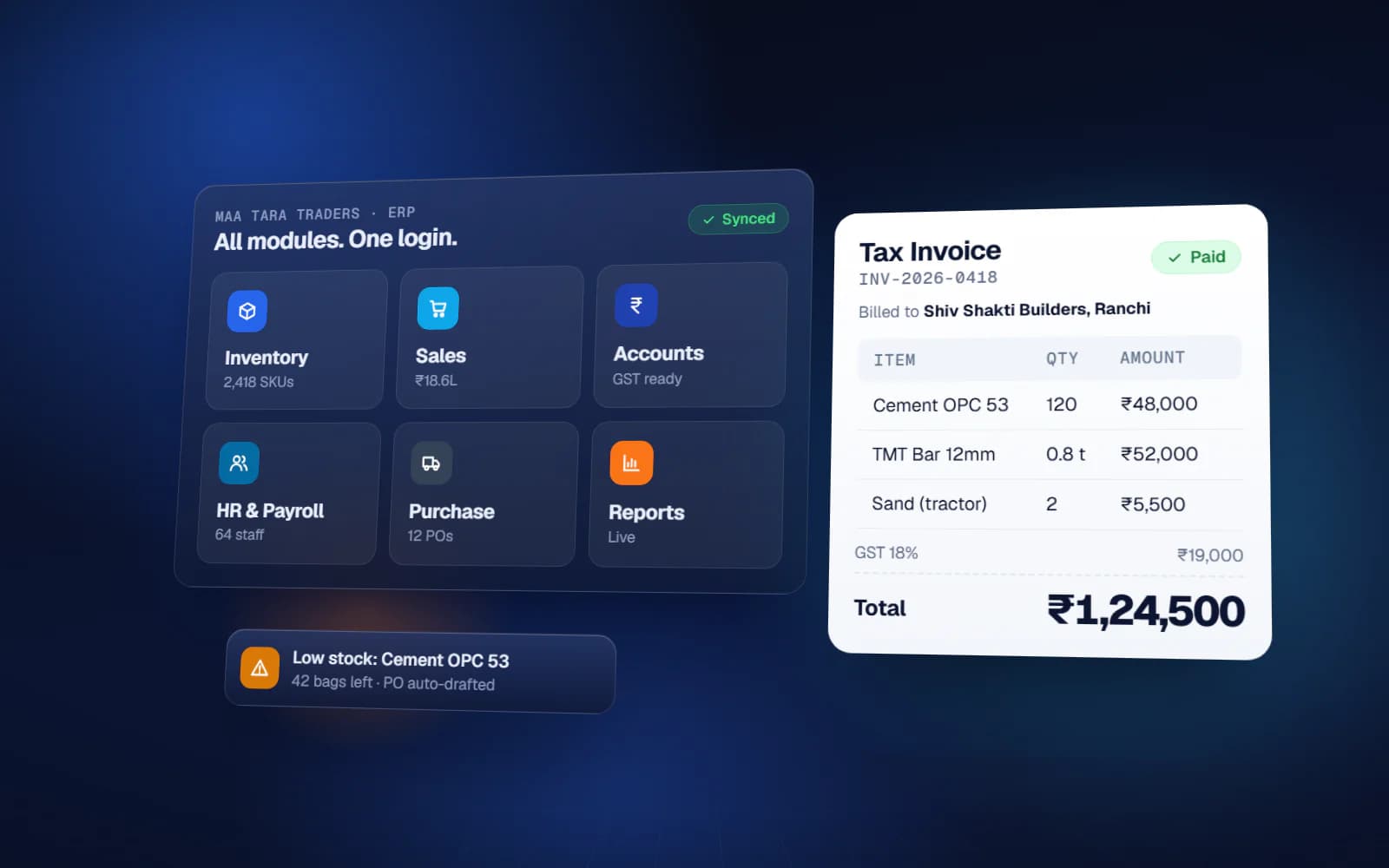
A custom ERP is built for your process — only the modules you use, in the order that pays back first. It can sit alongside Tally rather than replace it. Quality varies enormously by vendor, so what you are really buying is the vendor's process: discovery, documentation, testing and support.
Custom ERP vs SAP, Tally and Zoho: comparison table
| Factor | TallyPrime | Zoho | SAP Business One | Custom ERP |
|---|---|---|---|---|
| Best fit | Accounting, GST, basic inventory | Cloud-first SMEs, trading, services | Growing SMEs wanting a proven, structured ERP | Businesses with a genuinely distinct process |
| Flexibility | TDL customisation by partners | Configurable; Creator for extra apps | Configurable; add-ons via partners | Built to your workflow |
| Ownership | Licence to use; data stays with you | Subscription; data in Zoho cloud | Licence; hosting by you or partner | Code and data can be yours, if the contract says so |
| Integration | Many connectors; TDL and APIs | Strong within Zoho; APIs outside | APIs and partner add-ons | Whatever you scope — Tally, scales, WhatsApp, banks |
| Training effort | Low — accountants already know it | Low to moderate | Moderate to high | Depends on design; can be trained on your own data |
| Main cost drivers | Licence edition, TSS renewal, customisation | Users, apps, plan tier | Users, partner implementation, annual maintenance | Modules, integrations, migration, support |
Notice that the cost row has no numbers. Prices change, vary by user count and edition, and most importantly, the licence is rarely the biggest line. Implementation, data migration, training, customisation and years of renewals usually are.
When each option is the right choice
Choose Tally when
- Your main need is accounting, GST returns and a reasonable stock register
- Your accountant and CA already work in Tally and you do not want to change that
- Operations are simple enough that a few custom reports fill the gaps
Choose Zoho when
- You want cloud access from day one, with low upfront cost
- You are trading, distributing or selling services rather than running complex production
- You also need CRM, HR and helpdesk, and like the idea of one vendor for all of them
Choose SAP Business One when
- You are growing past what Tally can handle and want a proven, structured ERP with production and MRP
- You are ready for a partner-led implementation and a process change across departments
- Group reporting, audits or a foreign parent company expect a recognised ERP name
Choose custom ERP when
- Your process is genuinely different — unusual routing, site-based work, industry-specific billing
- You bought a packaged ERP and use only a fraction of it two years later
- Per-user licence costs keep rising as you hire people who only need one screen
- You need the system to work with Tally, weighing scales, WhatsApp or existing hardware without forcing a full switch
A common and sensible pattern in India is hybrid: Tally or Zoho Books stays for accounts and GST, and a custom system runs production, sites or operations, pushing entries to accounts. You do not have to pick one product for everything.
Total cost of ownership: what to add up
When comparing ERP for small business India options, compare five-year cost, not year-one price. List these for every option:
- Licence or subscription, multiplied by realistic user growth
- Annual renewals, maintenance or TSS
- Implementation or partner fees
- Customisation and reports you will need in the first year
- Data migration from your current system and spreadsheets
- Training, and the time your staff spend learning it
- Hosting and backups, if not included
- Cost of change requests after go-live
Risks people underestimate
- Packaged ERP: paying for modules nobody uses, and bending your process to the software
- Zoho or any cloud suite: being dependent on one vendor for many business functions
- SAP Business One: implementation quality depends heavily on the partner you choose
- Custom ERP: a vendor who builds without written scope, keeps the code, or disappears after go-live
The custom risks are real and worth guarding against in the contract. At Yuktantra our answer is process: discovery with the people doing the work, a written blueprint with scope, modules, integrations and timeline, then a quote that is fixed for that scope. The code repository, servers and accounts are in your company's name from day one, so there is no lock-in to design around. We do not publish a single ERP price, because scope varies too much between companies for one figure to be honest.
Questions to ask any ERP vendor
- Can you demo with our own products, customers and one real transaction?
- What will we pay in year three, including renewals and support?
- Who does the implementation, and what happens if that person leaves?
- How does it work with Tally and our CA's process?
- Who owns the data, and how do we export all of it if we leave?
- What is fixed in writing — scope, price, timeline, support response times?
Custom ERP vs SAP is not really a fight between two products. It is a question of how standard your process is, how much change your team can absorb, and who you want to own the system in five years.
FAQ
Is Tally an ERP?
TallyPrime is primarily accounting and inventory software with GST, e-invoicing, BOM and job work features. Many small businesses use it as a light ERP, but it does not replace production planning, shop-floor or project systems.
Tally vs Zoho Books — which is better?
Tally suits businesses whose accountant already uses it and who prefer a desktop licence. Zoho Books suits businesses that want cloud access and connect to other Zoho apps. Both handle GST; the better one is the one your team will actually use.
Is SAP Business One good for small businesses in India?
It is designed for small and mid-sized companies and covers finance, inventory, production and MRP. It fits best when you are ready for a partner-led implementation and some process change.
Is custom ERP better than SAP?
Neither is better in general. SAP Business One fits when your process is close to standard. Custom fits when your process is distinct, licence costs keep rising, or a packaged ERP is mostly unused.
Can a custom ERP work with Tally?
Yes. A common setup keeps Tally for accounts and GST, while the custom system runs operations and passes the entries Tally needs.